
1 year ago - edited
# aDOVkcMaXhSlHDAETo: <foundation.ets48@scpinet> <foundation.sci48@scpinet>
From: <smooth.sci48@scpinet>
Subject: SCP-106 Project Development.
Good day Engineers, Architects, and Mechanics,
SCP-106 has always been a very difficult SCP to contain leading to a lack of research on said subject, this is incredibly upsetting. I wish to commission you into the construction of a testing chamber designed specifically for SCP-106. I will appoint a lead project engineer who will be responsible for the projects construction. I have come up with a prototype design intended for holding SCP-106 for a temporary amount of time. Although unfortunate it is highly likely testing prototypes will result in a SCP-106 breach, I am willing to accept 3 Breaches before the project will be terminated. Seeing as this is the first major project for the engineering team, success will result in a special reward for those who contribute.
Any questions or inquiries may be answered here, those who are interested respond to this email. This email will not serve as the projects hub.
All Best Wishes and Encouragements!
-Dr. Smooth
-Attached Document Requiring Level 2 Security Clearance-
Prototype A
The SCP-106 Testing chamber is intended for the sample collection, study, and research of SCP-106. The testing cell will be an attachable/removable chamber that will hold SCP-106 for a temporary amount of time. Not intended to be a replacement for current containment procedure.
Requirements for Successful Prototype
-Cell capable of holding SCP-106 for at least 15 minutes.
-Cell capable of withstanding major corrosion damage.
-Enough Containment space to hold SCP-106 and at least 1 other humanoid subject.
-Replaceable Entrance for SCP-106 sample collection
Image 1 (Not to Scale)
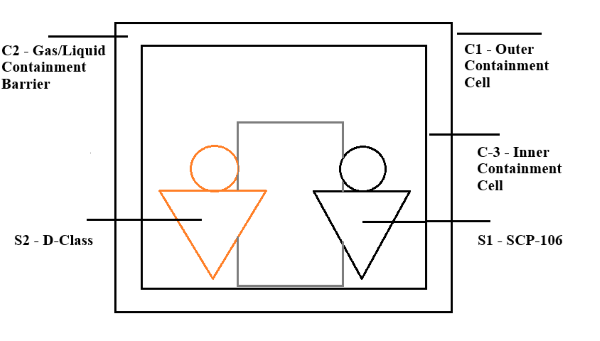
C-Containment
C1 Outer Containment Cell: An insulated shell made to contain the C2 Containment Barrier and house adjustment instruments, sensors, and B2 Hydraulic systems.
Adjust instruments will include pressure regulators and temperature regulators.
C2 Containment Barrier: The main method of preventing SCP-106 from breaching containment. A space between C1 and C3 filled with a constantly changing liquid/gas that will be manipulated by the C1 systems to adjust densities ensuring that the Inner and Outer Containment layers never come in contact. The barrier will likely be comprised of CO₂ although other considered elements such as H₂O, and He may achieve similar results.
C3 Inner Containment Cell: The holding space for SCP-106 and other subjects achieving a "float" state from the C2 Barrier. The cell will be equipped with interior monitoring methods.
S-Subject
S2 D-Class: An injured D-class personnel will be placed inside of the testing chamber to lure SCP-106 through D1 into the testing cell. Another injured D-class personnel will be placed inside the main containment chamber to lure SCP-106 back into normal containment after testing complete.
Image 2 (Not to Scale)
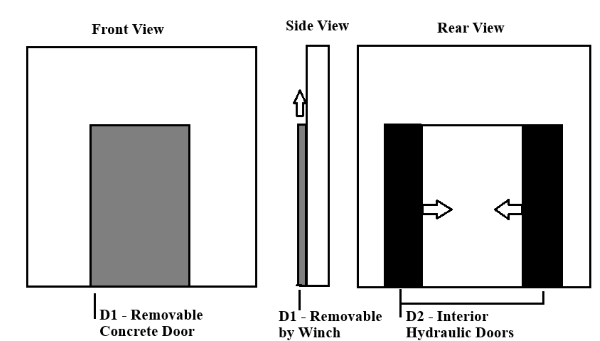
D-Door
D1 Concrete Slab: A specifically measured and replaceable concrete slab for SCP-106 to phase through mounted onto the outside of C1. Afterwards removed for corrosion sample collection.
D2 Hydraulic Doors: Remote hydraulic doors to be closed and opened upon SCP-106 entering the chamber through D1, and opened after test completion.
Image 3 (Not to Scale)
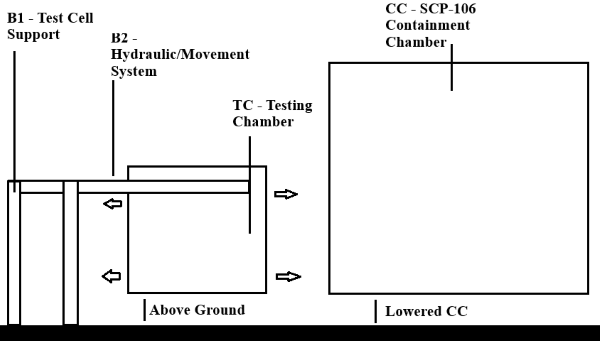
B-Base
B1 Cell Support: The support structure designed to hold the weight, hydraulic B2 system as well as carry the equipment needed for the operation of the test chamber.
B2 Movement System: Extendable hydraulic system to extend/retract the testing chamber from SCP-106's main Containment Chamber. Height above the ground is required for further breach deterring methods.
// yeah I used MS paint so what!